
Kingston expects to spend £18.5m more than its grant on special needs education this year, months after the government wrote off most of its old deficit.
Kingston expects to spend £18.5m more than its government grant on education for children with special educational needs and disabilities (SEND) this year. The figure comes in the same year the government agreed to write off most of the borough’s old deficit.
The projection is in a finance update to the Kingston Schools Forum, which meets online this afternoon, Monday 16 November. The report is written by Achieving for Children, which runs children’s services for the council.
Overview
- Spending on special needs education, known as the High Needs Block, is projected at £56.4m in 2026/27 against a budget of £37.9m.
- Across all of the Dedicated Schools Grant, the projected overspend is £18.515m.
- A new government grant of £22.093m writes off 90% of the deficit Kingston had built up by March 2026.
- Even after that grant, the fund is projected to be £16.954m in deficit by the end of March 2027.
- The number of education, health and care plans (EHCPs) rose from 2,169 to 2,222 between 31 March and the date of the report.
Where the money goes
The report puts this year’s projected spending on Dedicated Schools Grant services at £237.749m. The grant, including the money passed straight to academies, is £219.233m.
Almost all of the gap is in high needs. The report projects spending of £56,368,772 there, against a budget of £37,866,934. That includes £1.152m set aside for plans not yet agreed but expected before the year end.
The biggest single cost is “top-up” funding paid to schools for pupils with EHCPs. The borough expects to pay £22.5m for 1,289 such places this year, 133 more than at the end of 2025/26. The average cost differs by type of school:
| Type of school | Places | Average cost per place |
|---|---|---|
| Academies | 707 | £18,612 |
| Maintained schools | 344 | £14,011 |
| Schools outside the borough | 238 | £19,198 |
Independent and non-maintained placements for under-16s are projected to cost £7.2m, for 188 pupils. One of those placements costs more than £150,000 a year. Spending on young people over 16 is forecast at £8.7m, up from £7.7m last year.
The write-off, and what is left
Kingston was one of the councils in a “Safety Valve” agreement with the Department for Education (DfE). Under that deal the government paid money towards the deficit and the council made contributions from its own budget.
The report says the new High Needs Stability Grant writes off 90% of SEND deficits as they stood on 31 March 2026. It also refunds the council’s own contributions to the Safety Valve deal. Kingston’s figures are:
- a deficit of £57.88m before any Safety Valve payments or council contributions
- £52.09m of total government support, including £30m already paid under the Safety Valve deal
- £7.34m of that refunds the council’s own contributions
- a 10% share of £5.79m left for the council to bear
The grant was approved after the DfE signed off Kingston’s SEND Reform Plan.
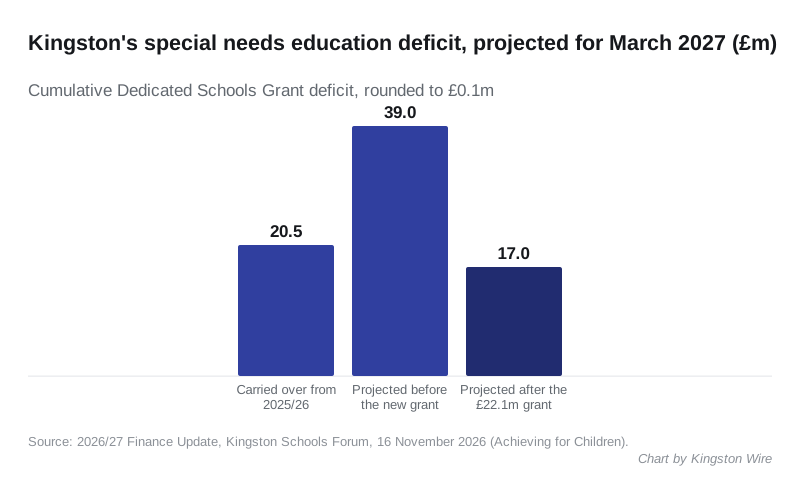
The deficit carried over from 2025/26 was £20.5m. Adding this year’s overspend takes it to a projected £39.0m by March 2027. The £22.1m grant brings that down to £17.0m.
The report says the government has not said what will happen to deficits that build up in 2026/27 and 2027/28. It quotes the DfE as promising “an appropriate and proportionate approach but that it will not be unlimited”. Any further help will depend on the council delivering its reform plan.
Malden Oaks places in the balance
Today’s meeting also decides how 2027/28 school funding is shared out. A second report sets out the results of a consultation with schools, which closed on 22 October.
One decision affects Malden Oaks. The report describes it as providing full-time education for secondary pupils who cannot attend a mainstream school. Many are at risk of exclusion, have been excluded, or are waiting for an EHC needs assessment.
Schools were asked how many places to fund at £28,000 each:
| Option | Places | Paid from schools’ budgets |
|---|---|---|
| 1: keep all places | 35 | £308,000 (11 places) |
| 2: reduce | 30 | £168,000 (6 places) |
| 3: reduce to the statutory places | 24 | nothing; all 24 from the High Needs Block |
73% of schools that answered backed option 3, cutting the unit to 24 places. Options 1 and 2 each had 13%.
Schools backed two other transfers from their budgets:
- £300,700 for the primary behaviour support and inclusion team, with 90% support
- £124,000 to continue a SEND “cluster” pilot to July 2027 and extend it to every school from September 2027, with 83% support
What it means for you
The deficit does not change any child’s entitlement. Councils must still meet the support written into an EHCP.
If your child has an EHCP or is being assessed, Achieving for Children’s SEND Local Offer lists the services in Kingston and how to ask for help.
Schools will get their individual budgets for 2027/28 at the end of February. The Forum meets again on Monday 18 January 2027.
Sources
- 2026/27 Finance Update, Kingston Schools Forum, 16 November 2026, for spending, the deficit, the stability grant and EHCP numbers
- 2027/28 Budget, Kingston Schools Forum, 16 November 2026, for the Malden Oaks options and consultation results
- Schools Forum agenda, 16 November 2026, Royal Borough of Kingston upon Thames
Have your say