
Kingston is targeting five fly-tipping hotspots and warning of £400 fines. Its own returns show 11 fly-tipping fines and no prosecutions in 2024/25.
Kingston Council has named five streets as fly-tipping hotspots and warned that dumping waste carries a fine starting at £400. The council’s own returns to government show it issued 11 fixed penalty notices for fly-tipping in the whole of 2024/25, against 2,390 recorded incidents, and prosecuted nobody.
The Let’s SCRAP fly-tipping campaign launched on 17 August with Veolia, the council’s waste and street cleansing contractor. It focuses on five locations:
- Old London Road
- Tolworth Close
- Ewell Road
- Burlington Road
- Rayleigh Court
Almost 900 letters have gone to households across the five streets, according to the council’s announcement. Veolia teams have handed out leaflets, put posters in charity shops and installed signs. Cleaning crews are stencilling anti-fly-tipping warnings onto pavements as soon as they clear a pile.
One of the five locations recorded no fly-tipping at all in July, against six incidents in June.
The enforcement gap
Every council in England reports its fly-tipping incidents and enforcement to Defra through WasteDataFlow. The 2024/25 return shows what Kingston did about the 2,390 incidents it logged:
| Action taken, 2024/25 | Number |
|---|---|
| Investigations | 1,193 |
| Duty of care inspections | 115 |
| Warning letters | 48 |
| Fixed penalty notices for fly-tipping | 11 |
| Formal cautions | 6 |
| Prosecutions | 0 |
| Vehicles seized | 0 |
That is 0.5 fixed penalty notices for every 100 incidents. Across London as a whole the figure was 2.6, and Ealing issued 1,993 notices, Harrow 1,242 and Westminster 1,171.
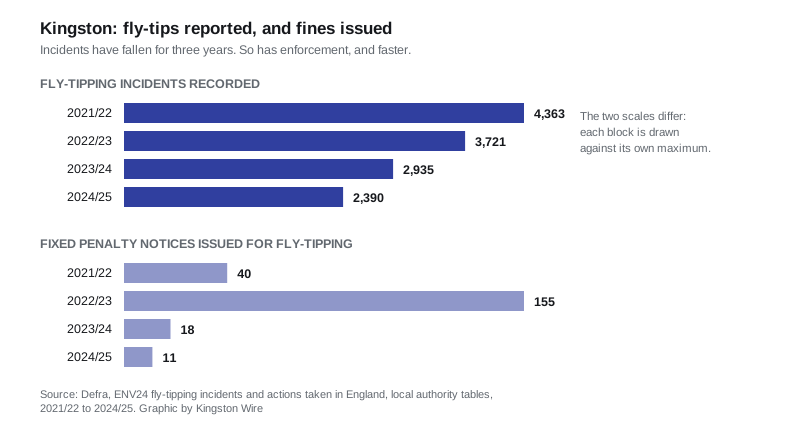
Kingston has also issued far fewer than it once did. The borough issued 40 fixed penalty notices for fly-tipping in 2021/22 and 155 in 2022/23. That fell to 18 in 2023/24 and 11 in 2024/25, while investigations rose from 885 to 1,193.
Kingston has less fly-tipping than anywhere else in London
The enforcement number sits alongside a genuinely good one. At 2,390 incidents, Kingston recorded fewer fly-tips in 2024/25 than any other London borough except the City of London, which logged 1,655. Croydon recorded 53,268 and Camden 36,216. Neighbouring Merton recorded 14,883, Richmond upon Thames 5,611 and Sutton 3,873.
The borough’s count has fallen for three years running, from a peak of 4,363 in 2021/22 to 3,721, then 2,935, then 2,390.
Defra warns against reading league tables too literally. Councils differ in how thoroughly they identify and log incidents, and the ones reporting the most are often the ones looking hardest.
Most of it is household waste rather than an organised operation. Of the incidents where the council recorded a size, 618 were a single black bag, 117 a single item, 561 a car boot or less and 880 a small van load. Nine were a transit van load. The largest single waste category was “other household waste”, at 648 incidents, followed by 384 household black bags.
What it means for you
Fly-tipping is reported to the council, not the police. Kingston has rebuilt its online reporting form with fewer steps and an optional photo upload that pulls the location out of the picture, so crews can find the pile. Scott Edgell, Veolia’s divisional head of municipal operations, said street cleansing teams have cleared “over 99% of reported fly-tips” within 48 hours this year.
The part that catches residents out is the duty of care. If you pay someone to take away a sofa or a load of garden waste and they dump it, you can be fined even though you did not dump it yourself. That penalty starts at £300. Check the person you are paying is a registered waste carrier before you hand anything over.
The council’s own routes are your kerbside recycling, a booked bulky waste collection, the Household Reuse and Recycling Centre, or a charity shop during opening hours. Leaving a working item next to a charity shop’s closed door is fly-tipping.
Councillor Nicola Nardelli, the deputy leader and portfolio holder for sustainable transport, waste and recycling, said keeping streets clean “is a shared responsibility” and that the campaign was part of “our ongoing work to prevent fly-tipping, educate residents and protect the places we all value”.
For what else is happening on the borough’s streets, our Kingston roadworks and travel page tracks the current closures, and the Kingston planning page follows the weekly application list.
Sources
- Kingston Council, “Time to SCRAP fly-tipping with new campaign targeting dumping hotspots in Kingston”, 17 August 2026, for the five locations, the 900 letters, the July figure, the penalty amounts, the reporting changes and both quotes.
- Defra, ENV24: fly-tipping incidents and actions taken in England, local authority tables 2012/13 to 2024/25, for Kingston’s incident counts, size breakdown, fixed penalty notices, investigations, cautions and prosecutions, and for the London comparisons.
- Kingston Council, report fly-tipping for the reporting route.
Have your say