
Band D in Kingston is £2,608.12 for 2026/27, the highest bill of any London borough. Full A to H charges, the Wimbledon Common levy, and every discount.
A band D home in Kingston pays £2,608.12 in council tax in 2026/27. That is the highest band D bill of any London borough. Kingston’s own share of it, £2,098.69 on the government’s measure, tops the table of all 33 London authorities, with Croydon £9 behind and Wandsworth £1,581 below.
The council raised its element by 4.99% this year, the maximum allowed without a referendum. The Greater London Authority added 4.1%. Together that is 4.8% on the total bill, or about £2.31 a week more for a band D household.
The full band A to H table for 2026/27
Most of the borough pays the figures in the “total” column. Homes within three-quarters of a mile of Wimbledon Common pay the fourth column on top.
| Band | Property value in 1991 | Kingston Council | GLA precept | Total | Total inside the Commons levy area |
|---|---|---|---|---|---|
| A | Up to £40,000 | £1,398.41 | £340.34 | £1,738.75 | £1,766.33 |
| B | £40,001 to £52,000 | £1,631.47 | £397.06 | £2,028.53 | £2,060.72 |
| C | £52,001 to £68,000 | £1,864.54 | £453.79 | £2,318.33 | £2,355.11 |
| D | £68,001 to £88,000 | £2,097.61 | £510.51 | £2,608.12 | £2,649.50 |
| E | £88,001 to £120,000 | £2,563.75 | £623.96 | £3,187.71 | £3,238.28 |
| F | £120,001 to £160,000 | £3,029.88 | £737.40 | £3,767.28 | £3,827.05 |
| G | £160,001 to £320,000 | £3,496.02 | £850.85 | £4,346.87 | £4,415.83 |
| H | Over £320,000 | £4,195.22 | £1,021.02 | £5,216.24 | £5,299.00 |
Source: the council’s own bands and charges page. The Kingston column includes the adult social care precept. Band values are 1991 values, not today’s.
How Kingston compares
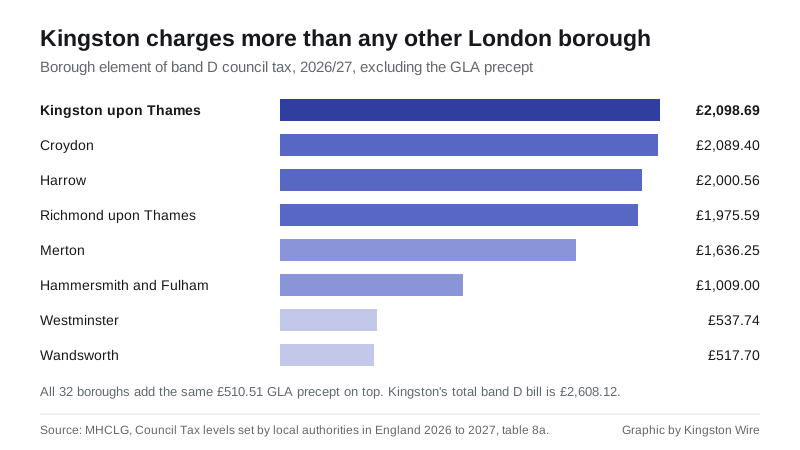
The government publishes the borough element of band D council tax for every authority each March. In the 2026-27 release, Kingston is first of 33 at £2,098.69.
Three of the four boroughs nearest the top are Kingston’s neighbours or near-neighbours: Croydon at £2,089.40, Harrow at £2,000.56 and Richmond upon Thames at £1,975.59. Sutton is seventh at £1,868.13 and Merton seventeenth at £1,636.25, the only borough alongside Westminster and Wandsworth to raise its charge by around 2% rather than the full 4.99%.
At the other end of the table the gap is enormous. Hammersmith and Fulham charges £1,009.00, Westminster £537.74 and Wandsworth £517.70, a quarter of Kingston’s figure. Every one of the 32 boroughs then adds the same £510.51 GLA precept.
The average band D bill across the whole of London, including the GLA precept, is £2,068 this year. Kingston’s £2,608.12 is £540 above that.
What you are paying for
The council set a budget of £205.70m at Budget Council on 26 February 2026. Council tax funds 70.59% of it, business rates 10.74% and government grants 14.95%.
Where the money goes, from the council tax booklet posted to every household:
- Adult social care and public health, £75.71m
- Children’s social care and education, £49.26m
- Residents and communities, £25.39m
- Place, £21.43m
- Corporate services and the chief executive’s office, £17.86m
- Central costs, £16.05m
More than 66% of the budget goes on people the council has a statutory duty to support. It names:
- 1,600 adults with long-term care needs, and a further 215 with shorter-term needs
- more than 1,000 children and young people receiving social care
- almost 2,000 with an education, health and care plan
- around 1,000 homeless families and individuals in temporary accommodation
The GLA’s £510.51 at band D funds London-wide transport, policing and the fire service, and is set by the Mayor of London rather than by Kingston.
There is no parish or town council precept anywhere in the borough, so the bill has only two parts for almost everyone.
The Wimbledon and Putney Commons levy
If your home is within three-quarters of a mile of the perimeter of Wimbledon Common, you pay an extra levy on top of the council tax. The distance is measured by the most direct route along roads and footpaths. In Kingston that means the Kingston Vale and Coombe end of the borough.
The levy runs from £27.58 at band A to £82.76 at band H, and it rose 3.22% this year. Kingston collects it and passes it to the Wimbledon and Putney Commons Conservators.
It exists because of the Wimbledon and Putney Commons Act 1871. That Act took the Commons out of Earl Spencer’s hands after a four-year Chancery suit. It put them under Conservators charged with keeping them open and unbuilt on, and wrote a rate on nearby residents into law to pay for it. The Conservators collected the rate themselves until 1991, when Kingston, Merton and Wandsworth took over. The Conservators publish a boundary map of the levy-paying area.
Checking and challenging your band
Bands are set by the Valuation Office Agency, not the council. Look yours up on the GOV.UK band search, and if you think it is wrong, the VOA handles challenges.
Bills go out once a year, usually in March. The default is 10 monthly instalments from April to January. You can ask to spread it over 12 instead, which cuts the monthly amount by about a sixth, using the council’s general council tax enquiry form.
Discounts and exemptions
Single person discount: 25%. You qualify if you are the only adult over 18 in the property, or the only one not already disregarded. You cannot claim it on a second home, or because someone has moved out temporarily without changing their main residence. The council runs periodic reviews and removes the discount if you do not respond, though you can reapply.
Council tax reduction: up to 100%. Kingston’s scheme allows a full write-off of the bill for those on the lowest incomes, which many councils cap well below that. The council says 7,100 working age and pension age residents get help with their council tax.
Two rules in that scheme are worth reading before you apply:
- 18 to 21 year olds are not eligible at all, unless they are care leavers. That has been the case since 1 April 2017.
- Non-dependant deductions for working age claimants are set 8.5% above the national prescribed figures, so another adult in the house costs you more here than the default.
Claims must be made online. Backdating is one month, extendable to 26 weeks at the council’s discretion for those it defines as vulnerable.
Kingston care leavers pay nothing until they turn 25. The 100% discount applies to care leavers from Kingston only, not from other boroughs, and only if they are liable for the bill. It is applied last, after any single person discount or council tax reduction. A care leaver living with one other person is disregarded, cutting that person’s bill by 25%. It does not apply in a house in multiple occupation, where the landlord is liable.
Students in halls or in an all-student household are exempt. So are households where everyone is under 18, everyone is severely mentally impaired, or the occupants are UK or visiting armed forces or foreign diplomats.
Young adults aged 18 and 19 can be disregarded on two conditions. They must be on a further education course lasting more than three months, with more than 12 hours of study a week, and their parent or guardian must be able to claim child benefit for them. School and college leavers who finish after 30 April are exempt until the following November.
Other discounts cover carers, people with disabilities, people detained by law, religious communities and annexes. The council lists them all.
Empty homes and second homes
Kingston charges the full rate on an empty property, and then adds a premium the longer it stays empty:
| How long the property has been empty | You pay |
|---|---|
| Under 1 year | The full band charge |
| 1 to 5 years | Twice the band charge |
| 5 to 10 years | Three times the band charge |
| More than 10 years | Four times the band charge |
The premium attaches to the property, not the owner. Buy a house that has stood empty for six years and leave it empty, and you inherit the 200% premium from day one.
Second homes carry a 100% premium from 1 April 2025, so a furnished property where nobody lives, or where the owner’s main home is elsewhere, pays double. There is no minimum period and no right of appeal against the decision to charge it. The only route out is proving the property is someone’s main residence, with a tenancy agreement or a closing bill from a previous address.
At band H, a property empty for more than a decade would be billed four times £5,216.24, or just under £20,865 a year.
Related: Kingston bin collection days, parking in Kingston and Kingston house prices.
Have your say