
Kingston's draft Local Plan allocates 55 sites for nearly 20,000 homes by 2043, including four council car parks and the Guildhall. Comments close Friday.
The last chance to comment on the plan that will govern building in Kingston for the next fifteen years runs out on Friday. The borough’s draft Local Plan allocates 55 specific sites for development and plans for nearly 20,000 homes by 2043. Four of the council’s own car parks are on the list, along with the Guildhall, Kingston railway station and the former Chessington Golf Course.
There is a discrepancy in the closing time that is worth knowing about. The council’s Local Plan page and its consultation portal both give the deadline as 11.59pm on Friday 4 September 2026. The council’s own statutory notice of public consultation, published under Regulation 19, says the consultation closes at 5pm on 4 September. Submit by 5pm and the point does not arise.
What the plan proposes
The Local Plan covers 2028 to 2043. Its summary document says the council is “planning for nearly 20,000 homes to be delivered over the next 15 years”. The council’s separate statement on the London Plan puts the same figure at “around 19,000 homes”. Spread evenly across the 15 years that is about 1,300 a year, though the plan splits its own delivery schedule into pre-adoption, years 1 to 10 and years 11 to 15 rather than assuming a flat rate.
New housing is directed to four types of location:
- Key Areas of Change
- the most sustainable and accessible places, including the metropolitan and district town centres
- specific Green Belt sites the council has identified as “grey belt” and considers sustainably located
- specific brownfield sites inside Metropolitan Open Land
Those last two are the part that will draw objections. The council is blunt about why: “Due to the insufficient supply of brownfield land, the Council must identify specific areas of Green Belt land for release.”
On affordable housing, the draft plan sets three different requirements:
- 35% of homes on privately owned land
- 50% of homes on public sector land
- 50% of homes on Green Belt and Metropolitan Open Land
It also commits to at least 52 permanent gypsy and traveller pitches over the ten years to 2031/32, acknowledging what it calls a significant backlog.
The 55 sites, and where they are
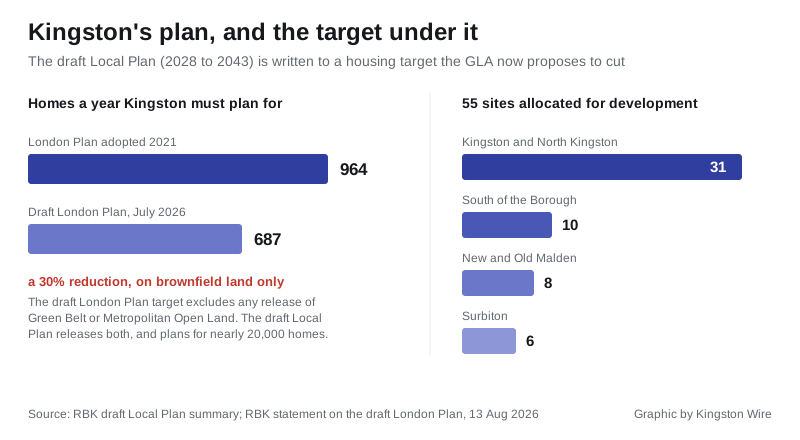
The allocations are grouped by neighbourhood. Kingston and North Kingston carries more than half of them.
| Neighbourhood | Sites | Includes |
|---|---|---|
| Kingston and North Kingston | 31 | Eden Walk Shopping Centre, John Lewis on Wood Street, Guildhall 1 and 2, Kingston railway station, Cromwell Road bus station, Cambridge Road Estate |
| South of the Borough | 10 | Former Chessington Golf Course, Green Lane Farm Kennels, Hollywood Bowl on Kingston Road, Tolworth railway station, Chessington World of Adventures |
| New and Old Malden | 8 | Cocks Crescent, Burlington Retail Park, CI Tower, the West Barnes Lane gasholder, the former Worcester Park Tavern |
| Surbiton | 6 | Tolworth Tower, Surbiton station car park, Surbiton telephone exchange, Chiltern Works in Berrylands, Hogsmill sewage works site 2 |
Four of the council’s ten car parks are allocated for redevelopment: Ashdown Road, Bittoms, Canbury Place and the Cattle Market surface car park. The Bentall Centre’s car parks A and B are allocated too, as is Seven Kings car park at Sury Basin. Anyone who parks in Kingston to shop or to catch a train has until Friday to say something about that. Current tariffs and opening hours are on our Kingston roadworks and travel page.
Four Kingston University sites are allocated: Knights Park, Kingston Hill, Penrhyn Road and Tolworth Court. The plan marks land at Coombehurst Quarter on the Kingston Hill campus as suitable for housing. So is Kingston College on Kingston Hall Road.
The target the plan is built on is about to be cut
Kingston’s draft plan has to conform with the London Plan adopted in 2021, which sets the borough a minimum of 964 homes a year.
That number is being replaced. The Greater London Authority published its draft London Plan on 16 July 2026. According to the council’s own statement on it, updated on 13 August:
- the draft London Plan sets a London-wide target of 558,000 homes as a minimum over ten years, against the government’s current target of 880,000
- Kingston’s share falls to 687 homes a year, a 30% reduction on the current government target
- that draft target is based on using brownfield land only, and excludes the release of any Green Belt or Metropolitan Open Land
So the plan Kingston is about to submit releases grey belt and Metropolitan Open Land to reach a target that the GLA now proposes to cut by nearly a third, using a calculation that assumes no such release happens.
The council’s answer is timing. It says the draft London Plan is at a very early stage and will not be adopted until 2028 at the earliest, while Kingston has to submit its Local Plan to the Planning Inspectorate before a government deadline at the end of December 2026. Examination in public is expected in 2027, with adoption possible in 2028.
The habitats assessment is not finished
A Habitats Regulations Assessment is one of the things the council itself lists as a legal compliance requirement for a Local Plan, alongside a Sustainability Appraisal and a Strategic Environmental Assessment. It tests whether a plan’s policies could significantly affect protected wildlife sites.
Kingston’s is not ready. The council says the work “is currently being finalised” and will therefore be consulted on separately from the main plan, in a standalone six-week consultation expected to launch once the document is finished in September 2026.
The council says the assessment work completed so far “has not identified any issues requiring changes to any policies or site allocations in the draft Local Plan”. It adds that responses to both consultations will go to the Planning Inspectorate together by December 2026, so nobody’s ability to influence the plan is affected.
What it means for you
This is the Regulation 19 stage, which is narrower than the earlier rounds. The council is not asking whether you like the policies. It is asking whether the plan is legally compliant and sound, which the National Planning Policy Framework defines at paragraphs 36 to 38 as positively prepared, justified, effective and consistent with national policy.
That matters practically. A comment saying you object to housing on the former Chessington Golf Course will carry less weight than one arguing the evidence behind that allocation does not justify it, or that the infrastructure to support it is not deliverable.
Two things people miss:
- Say if you want to speak at the examination. The statutory notice asks anyone commenting to state whether they would like to appear before the inspector, if selected. Ask now or you are relying on being invited.
- Only comments made in the consultation window count. The council’s portal is explicit: “Only those representations made within the period set by the Council will be taken into account by the Inspector as part of the examination.”
Four ways to respond, all before Friday:
- the online response form on the council’s Local Plan page
- email localplan@kingston.gov.uk
- post to Spatial Planning Team, Royal Borough of Kingston upon Thames, Guildhall 2, High Street, Kingston upon Thames, KT1 1EU
- pick up a feedback form and a stamped addressed envelope from any open library in the borough, or the Information and Advice Centre at Guildhall 2
The full draft plan is a 20MB PDF, so start with the summary document instead. The borough’s planning page tracks the weekly applications list in the meantime, and the house price figures are the other half of the argument about how much Kingston needs to build.
Sources
- Kingston Council Local Plan page for the 11.59pm 4 September deadline, the Habitats Regulations Assessment split, the submission timetable and the soundness tests.
- Notice of public consultation under Regulation 19, Royal Borough of Kingston upon Thames, for the 5pm closing time and the request to state whether you wish to speak at the examination.
- Kingston’s Local Plan Regulation 19 consultation on Kingston Let’s Talk, and its summary document, for the nearly 20,000 homes figure, the 55 site allocations and their names, the four neighbourhood groupings, the affordable housing percentages, the gypsy and traveller pitches and the response routes.
- Kingston Council statement on the draft London Plan consultation, updated 13 August 2026, for the 558,000 and 880,000 London-wide figures, Kingston’s 687 homes a year, the 30% reduction, the brownfield-only basis and the 964 a year current requirement.
Have your say